

Quick answer
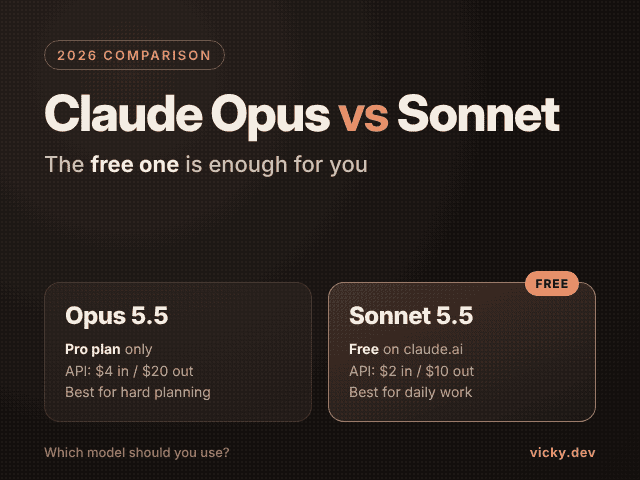
Use Claude Sonnet 5.5 for most daily work. It is faster, costs half as much, and free users get it on claude.ai. Pick Claude Opus 5.5 when the task is long, complex, or needs careful judgment. Think big refactors, deep research, or hard decisions. Opus needs a paid plan.
- Sonnet 5.5: fast, cheap, and strong at coding, writing, documents, and everyday tasks.
- Opus 5.5: slower and twice the price, but stronger on hard, open-ended work.
My rule: start with Sonnet. Switch to Opus only when Sonnet gets stuck.
Claude Opus 5.5 vs Sonnet 5.5 at a glance
Both models share the same context window and output limit. The real gaps are price, speed, and who can use them.
| Feature | Claude Opus 5.5 | Claude Sonnet 5.5 |
|---|---|---|
| Released | September 22, 2026 | September 28, 2026 |
| Best for | Complex work that needs careful judgment | Everyday tasks, bug fixes, documents |
| Speed | Moderate | Fast |
| Context window | 1M tokens | 1M tokens |
| Max output | 128K tokens | 128K tokens |
| API input price (per 1M tokens) | $4 | $2 |
| API output price (per 1M tokens) | $20 | $10 |
| Cache reads (per 1M tokens) | $0.20 | $0.10 |
| Default effort on the API | Medium | High |
| Free on claude.ai | No, needs Pro | Yes |
Sources: Opus 5.5 docs, Sonnet 5.5 docs, Anthropic Sonnet 5.5 page.
Anthropic cut Sonnet 5.5 cache reads in half, from $0.20 to $0.10, on October 7, 2026.
What is the real difference between Opus and Sonnet?
Opus is the deep thinker. Sonnet is the fast worker. Both are smart, but they are built for different jobs.
Anthropic built Opus 5.5 for long, complex work. That means coding agents that run for hours, large refactors, and system engineering. Opus always thinks before it answers. You cannot turn that off.
Anthropic calls Sonnet 5.5 a faster, cheaper partner to Opus. It shines on clear, well-defined tasks. Fixing bugs, writing documents, and building slides or spreadsheets are its sweet spot.
The gap is smaller than it used to be. On many tests, Sonnet 5.5 lands within a few points of Opus. Sometimes it even wins. So the question is no longer “which is smarter?” It is “does this task need the extra judgment?”
When should you use Claude Opus 5.5?
Use Opus 5.5 when a wrong answer costs you time or money. It is worth the extra price for work where judgment matters more than speed.
Good jobs for Opus:
- Large codebases. Refactoring many files, planning architecture, or tracking down a bug that spans the whole project.
- Long agent tasks. Coding agents that run for hours without you watching.
- Deep research and analysis. Long reports, contracts, or financial documents where small details matter.
- Hard decisions. Open-ended problems with no clear right answer.
- Vision-heavy work. Reading complex screenshots, charts, and diagrams.
Skip Opus for quick questions, short emails, or simple fixes. You will pay more and wait longer for the same result.
When should you use Claude Sonnet 5.5?
Use Sonnet 5.5 for almost everything else. For most people, it should be the default model.
Good jobs for Sonnet:
- Everyday coding. Fixing bugs, writing functions, explaining code, and writing tests.
- Writing. Blog posts, emails, summaries, and documentation.
- Office work. Slides, spreadsheets, and polished documents. Anthropic says it has a sharp eye for design too.
- Quick answers. Research questions, brainstorming, and learning new topics.
- High-volume API work. Chatbots, content pipelines, and anything that runs thousands of requests.
Sonnet 5.5 is also more than 30% faster than Sonnet 5. It uses fewer tokens per task, so real costs can drop by up to 30%. That adds up fast if you pay for the API.
Opus vs Sonnet benchmarks: which one wins?
Opus 5.5 wins most of Anthropic’s official benchmarks, but only by 1 to 3 points. Sonnet 5.5 wins the big agentic coding test, Terminal-Bench 4.0, by about 4 points.
| Benchmark | What it tests | Opus 5.5 | Sonnet 5.5 | Winner |
|---|---|---|---|---|
| Terminal-Bench 4.0 | Agentic coding in a terminal | 66.4% | 70.6% | Sonnet |
| CursorBench 4.0 | Coding agent tasks | 57.8% | 55.5% | Opus |
| FrontierCode 1.1 | Hard coding problems | 54.4% | 52.1% | Opus |
| GDPval-AA v2.1 | Real work across 44 jobs | 1,846 | 1,844 | Opus (by 2 points) |
| Humanity’s Last Exam (with tools) | Expert-level questions | 67.7% | 64.5% | Opus |
| OSWorld 2.1 | Using a computer | 81.8% | 80.1% | Opus |
| Cartography (no tools) | Reading charts | 64.4% | 61.6% | Opus |
Source: Anthropic, Claude Sonnet 5.5. Opus ran Terminal-Bench at its highest effort level. Sonnet’s FrontierCode score is also at its highest effort level.
An independent run agrees on the coding result. Artificial Analysis scored Sonnet 5.5 at 63.6% and Opus 5.5 at 59.6% on Terminal-Bench 4.0 (Decrypt). So Sonnet wins agentic coding at half the price, while Opus edges ahead almost everywhere else.
One warning: benchmarks are not your work. Anthropic still says Opus 5.5 is clearly stronger on complex work that needs sustained judgment. Default settings differ too. On the API, Sonnet runs at high effort and Opus at medium. Compare them at the same effort level for a fair test.
Pricing: Is Opus worth twice the cost?
Opus 5.5 costs exactly twice as much as Sonnet 5.5 on the API. On claude.ai, the bigger difference is that Sonnet is free and Opus is not.
Which model can you use on each plan?
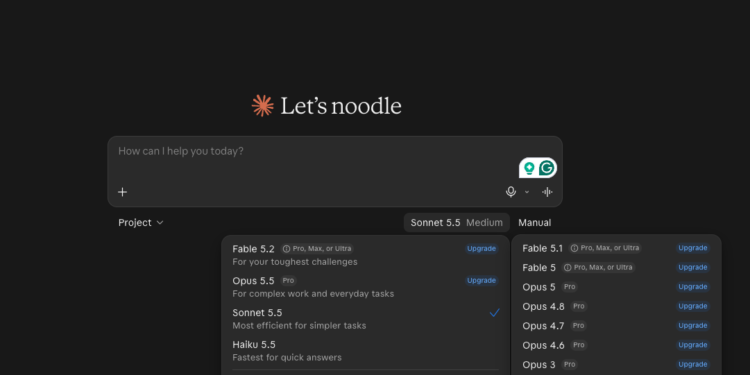
I checked the model picker in claude.ai on November 25, 2026. Here is what each plan unlocks.
| Plan | Models you can pick |
|---|---|
| Free | Sonnet 5.5 (default), Haiku 5.5, Sonnet 5, Sonnet 4.6 (until December 8) |
| Pro | Everything in Free, plus Opus 5.5 and older Opus models |
| Max and Ultra | Everything in Pro, plus Fable 5.2 |
Pro users can also use Fable with usage credits.
 Want to stay on the free plan? Read my guide on how to use Claude for free.
What does it cost on the API?
Say you send 1 million input tokens and get 200,000 output tokens back.
- Opus 5.5: $4 + $4 = $8
- Sonnet 5.5: $2 + $2 = $4
Two more costs to know:
- Fast mode for Opus runs up to 2.5 times faster. It costs $8 per million input tokens and $40 per million output tokens. (source)
- The Batch API gives a 50% discount on input and output if you can wait for results. (source)
So is Opus worth it? For hard tasks, yes. One good answer from Opus can beat three tries with Sonnet. For routine work, Sonnet gives you nearly the same result for half the price.
Opus vs Sonnet in Claude Code
In Claude Code, you can switch between both models anytime. The smartest setup uses both: plan with Opus, then build with Sonnet.
Both models run at medium effort by default in Claude Code. Here is how to switch:
# start a session on either model
claude --model sonnet
claude --model opus

# switch in the middle of a session
/model sonnet
/model opus

# raise the thinking effort for a hard task
/effort high

My workflow:

Ask Opus to read the codebase and write a plan.
Review the plan yourself.
Switch to Sonnet and let it write the code, step by step.
Switch back to Opus if Sonnet gets stuck on a tricky bug.

Sonnet costs half as much per token, so your usage limit lasts longer. Claude Code also has a built in `opusplan` model alias that uses Opus for planning and Sonnet for the coding. Need Opus faster? Type `/fast` to turn on fast mode.
Note: Claude Code needs a paid plan. New to it? Start with my Claude Code install guide.
Where do Haiku 5.5 and Fable 5.2 fit?
Opus and Sonnet are not the only choices. Claude now has four tiers, from fastest to most powerful:
- Haiku 5.5: the fastest and cheapest. Great for quick answers and huge volumes. Released October 7, 2026, and free on claude.ai.
- Sonnet 5.5: the best mix of speed and smarts. The default for most people.
- Opus 5.5: for complex work. Needs Pro.
- Fable 5.2: the top tier, made for your toughest challenges. Included in Max and Ultra, or with usage credits on Pro.
For most readers, the real choice is still Sonnet or Opus. Haiku is for speed. Fable is for the rare task even Opus cannot crack.
How I actually use Opus and Sonnet
My main Claude account runs both models, so I switch between them every week. Here is how I split the work.
- Sonnet does almost all my writing. Drafts, outlines, edits, and rewrites all go to Sonnet. It is fast, and for writing I rarely see a gap that would justify paying for Opus.
- For most people, Sonnet is more than enough. I mean real day-to-day work here, not just casual chat. Professional tasks and coding included. Most people will never hit a wall with Sonnet.
- Opus gets the work that needs planning. Some tasks need more than skill. They need someone to step back and think through the whole problem. That is where Opus earns its price.
- A real example. About a month ago, I was building a RAG-based app, the kind that answers questions from your own documents. Sonnet kept looping. It tried the same fixes again and again and never found the real problem. I switched to Opus. It looked at the whole setup and found the gap Sonnet kept missing.
- Haiku handles the simple, repeated jobs. For summaries, rewrites, and repetitive tasks, even Haiku does the job well. We use Haiku in some of our own apps to keep API costs under control.
That gave me the rule I still follow. Let Haiku take the simple, repeated jobs. Let Sonnet do the real work. Bring in Opus when the problem needs real planning, or when Sonnet starts going in circles.
Frequently asked questions
Is Claude Opus better than Sonnet?
Opus is better at complex work that needs careful judgment. Sonnet is better at speed and cost, and it beats Opus on Terminal-Bench 4.0, a key agentic coding test. For most daily tasks, you will not notice a big quality gap.
Is Claude Opus 5.5 free?
No. Opus 5.5 needs a Pro plan or higher on claude.ai. Free users get Sonnet 5.5, Haiku 5.5, and Sonnet 5.
Which is better for coding, Opus or Sonnet?
For everyday coding, Sonnet 5.5. It scored 70.6% on Terminal-Bench 4.0, ahead of Opus at 66.4%. But Opus leads on CursorBench 4.0 and FrontierCode 1.1. For large refactors or architecture planning, Opus is still the safer pick.
How much cheaper is Sonnet than Opus?
Sonnet 5.5 costs half as much. It is $2 per million input tokens and $10 per million output tokens. Opus 5.5 is $4 and $20.
Do Opus and Sonnet have the same context window?
Yes. Both handle 1 million tokens of context and up to 128,000 output tokens.
Can I switch between Opus and Sonnet in one chat?
Yes. On claude.ai, pick a model from the menu under the message box. In Claude Code, type /model opus or /model sonnet.
What is the difference between Opus 5.5 and Fable 5.2?
Fable 5.2 sits above Opus as Claude’s top tier. It is built for the toughest tasks and comes with Max and Ultra plans.
Final verdict: Opus or Sonnet?
Pick Sonnet 5.5 as your default. It is fast, half the price, free on claude.ai, and it beats Opus on Terminal-Bench 4.0.
Pick Opus 5.5 when the task is big, risky, or unclear. Pay for it when one careful answer saves you hours.
The best setup uses both. Let Opus think and plan. Let Sonnet do the work.