


You’ve built a blog. Traffic is growing. Now everyone says it’s time to monetize.
Two names keep coming up: AdSense and Mediavine Journey.
Both are legitimate ad networks. Both put ads on your site and pay you money. But they work very differently — and the wrong choice can cost you real income.
I’ve used both on vicky.dev. This is my honest breakdown of what’s better between Mediavine Journey vs AdSense.
What Is AdSense?
Google AdSense is the default starting point for most bloggers.
It’s run by Google. It’s free to join. And you can apply with almost no traffic.
Google reviews your site, approves it (or not), and you start showing ads. You earn money every time someone clicks an ad. This model is called CPC — cost per click.
AdSense is everywhere. Millions of websites use it. It works, but it has a ceiling.
What Is Mediavine Journey?
Mediavine is a premium ad management company. Their main network requires 50,000 sessions per month.
But in 2023, they launched Journey by Mediavine — a program built specifically for smaller blogs.
Journey has a much lower barrier to entry. You need just 1,000 sessions per month to qualify. Once approved, Mediavine manages your ads entirely. They use a model called RPM — revenue per thousand impressions.
You don’t wait for clicks. You earn from every pageview.
AdSense vs Journey: The Key Differences
Minimum Traffic Requirement
AdSense has no minimum traffic requirement. You can apply with 100 monthly visitors.
Journey requires at least 1,000 sessions per month. This is a real barrier for new blogs, but it’s there for a reason — your site needs to be big enough to attract quality advertisers.
How You Earn Money
This is the most important difference.
AdSense pays per click. If no one clicks, you earn almost nothing. Click-through rates on most blogs hover between 0.5% and 2%. Most visitors never click an ad.
Mediavine Journey pays per impression. Every pageview counts. The metric is called RPM (Revenue Per Mille) — what you earn per 1,000 pageviews.
A site with Journey-level RPM earns money even from readers who bounce after one page.
Revenue Potential
AdSense RPMs for most content blogs range from $1 to $5, depending on your niche and audience location.
Journey RPMs are significantly higher. Many publishers report RPMs between $10 and $25 for English-language content targeting US or UK audiences. Some niches go even higher.
The gap is real. At the same traffic level, Journey almost always earns more.
Ad Quality and User Experience
AdSense gives you limited control. Google decides what ads show. You can block categories, but the overall experience depends on whatever advertisers are bidding on Google’s network.
Mediavine has stricter advertiser standards. Their ads tend to be less intrusive. They also give you more control over ad density and placements. Publishers often report that their Core Web Vitals stay healthier with Mediavine’s ad code compared to poorly optimized AdSense setups.
Setup and Management
AdSense requires you to place the ad code manually. You decide where ads go. This gives you control but also requires effort and testing.
Journey is fully managed. Mediavine’s team optimizes your ad layout. You do almost nothing after setup. This is a major advantage if you’d rather write content than manage ad placements.
Payment Threshold and Schedule
AdSense pays when you hit $100 in earnings. Payments go out monthly. For low-traffic sites, it can take months to reach the payout threshold.
Mediavine pays 65 days after the end of the month in which your earnings were made. The threshold is lower — $25. For most blogs, this means you hit payout every single month once you’re earning consistently.
Support
AdSense support is notoriously difficult to reach. Most communication goes through a help center. If your account gets suspended or flagged, getting a real answer takes time.
Mediavine has an active publisher community and responsive support. They have a Facebook group with tens of thousands of publishers where you can ask questions and get real answers fast.
Who Should Use AdSense?
AdSense makes sense in a few specific situations.
- You’re just starting. If your blog has fewer than 1,000 monthly sessions, you don’t qualify for Journey. AdSense is your only real option among major networks. Start there, grow your traffic, and transition later.
- Your audience is not primarily the US or the UK. AdSense CPCs can still be decent for certain niches even with international traffic. Journey RPMs are strongest for English-language blogs with American readers.
- You want zero barriers. AdSense approval is quick for sites with original content. If you want to start earning right away, AdSense lets you do that.
- Who Should Use Mediavine Journey?
- Journey is the right move if you meet the traffic requirements.
- You have 1,000+ monthly sessions. This is the minimum. If you’re close but not there yet, focus on SEO and content before applying.
- You write content in English for a US or Canadian audience. Journey’s RPMs are highest for these demographics.
- You want a managed solution. Journey handles everything. You write content. They handle the ads. That’s a good trade for most content creators.
- You’re thinking long-term. Once you hit 50,000 sessions, you can graduate to the full Mediavine network with even higher RPMs. Journey gets you in the door early.
My Honest Transition: The $68 Dilemma
Most gurus tell you to switch the second you qualify. I did exactly that, and here’s what they don’t tell you: the ‘Ghost’ period.
When I hit 32,000 monthly visitors (verified via Ahrefs), I was finally seeing a steady $2.00/day on AdSense. It wasn’t life-changing, but it was consistent. After getting approved for Journey, I installed their script and waited.
One week passed. Then two. Then three. I was seeing ‘placeholder ads’ and my total earnings for 21 days were a measly $1.20. Meanwhile, I had $68 sitting in my AdSense account—stuck because I hadn’t hit the $100 payout threshold.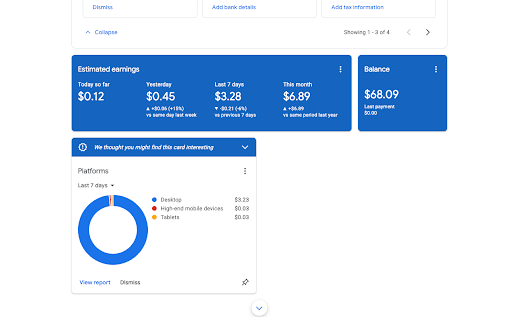
The Strategy: I actually switched back to AdSense temporarily. Why? As a developer and business owner, I don’t leave money on the table. I’m currently finishing that $100 payout. Once that hits my bank account, I’m moving back to Journey with a long-term mindset.
My Lesson: If you switch, be prepared for a ‘calibration month’ where earnings might look scary. Don’t panic, the advertisers need time to ‘bid’ on your new inventory.”
The Numbers That Matter
Let’s put this in simple math.
- Say your blog gets 20,000 pageviews per month.
- With AdSense at a $3 RPM, you earn roughly $60/month.
- With Journey at a $15 RPM, you earn roughly $300/month.
- Same traffic. Five times the revenue. That’s the difference a premium network makes.
These numbers will vary based on your niche, content quality, and audience location. But the gap between AdSense and Journey RPMs is real and consistent.
Can You Use Both?
No. Mediavine Journey is an exclusive agreement.
When you join Journey, you agree to let Mediavine manage all display advertising on your site. You cannot run AdSense alongside it. This is standard for all premium ad networks.
The good news: you won’t want to. The RPM lift from Journey more than compensates for dropping AdSense.
Quick Comparison Table
| Feature | AdSense | Mediavine Journey |
| Minimum Traffic | None | 1,000 sessions/month |
| Payment Model | CPC (cost per click) | RPM (per impression) |
| Typical RPM | $1–$5 | $10–$25 |
| Management | Self-managed | Fully managed |
| Ad Quality Control | Limited | High |
| Payment Threshold | $100 | $25 |
| Support | Limited | Strong community |
| Exclusivity | No | Yes |
The Verdict on Mediavine Journey vs AdSense
Here’s the simple answer:
Use AdSense if you’re under 1,000 sessions per month.
Switch to Mediavine Journey the moment you cross that threshold.
AdSense is a starting point, not a destination. It gets money coming in while you grow. But once you qualify for Journey, staying on AdSense means leaving significant revenue on the table every single month.
Build your traffic. Apply to Journey. Don’t overthink it.
Note – The significant change everyone talks about comes into play when the traffic increases. If your traffic is less, the difference may not be that much.
Have questions about either network? Drop them in the comments below.